


Free & confidential peer-led support
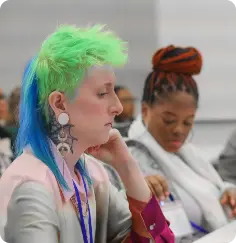
Healing happens in community. Connect with people who understand and support one another.
Sign up for a virtual or in-person support group
About our support groups
NAMI Chicago offers free support groups for adults living with mental health conditions and for family members, friends, and caregivers supporting someone on their mental health journey.
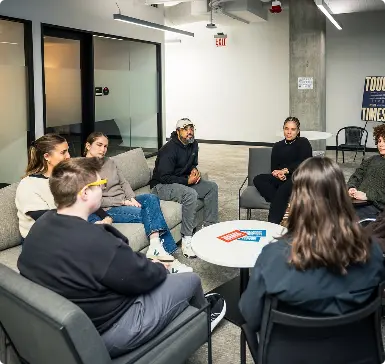
Our groups are peer-led and confidential, creating a space where people can talk openly with others who understand their experiences.
Most groups are offered virtually, with some in-person options available through community partnerships.
Participants must be 18 years or older.
Peer Support Group
A peer-led support group for adults managing mental health symptoms or conditions. Groups are facilitated by trained peers who share similar lived experiences.
Peer support groups are offered virtually throughout the week. We also host an in-person peer support group in Ravenswood in partnership with Thresholds, open to the community.
Family Support Group
A support group for family members, friends, and caregivers supporting someone living with a mental health condition.These peer-led groups provide space to share experiences, learn from others, and connect with people facing similar challenges.
Family support groups are offered virtually with alternating daytime and evening sessions.
LGBTQ+ Peer Support Group
A peer-led support group for LGBTQ+ identifying individuals. This group offers a welcoming space to talk about mental health, identity, and the unique challenges faced by the LGBTQ+ community.
Groups meet virtually every other Thursday evening.
Spanish Peer Support Group
An in-person peer support group conducted in Spanish for adults living with mental health conditions.
This group is hosted in partnership with Blue Door in Cicero and meets in person the first and third Tuesday of every month.
Stories of Our Lives
A reading-based peer support group where participants explore short stories connected to everyday life stressors. The stories serve as a starting point for reflection, conversation, and connection with others.
This group meets virtually on Monday evenings.
Meet our facilitators
Emily Eggleston
EMILY’S APPROACH
Ashwak Mansour
ASHWAK’S APPROACH
“Peer support means living the values I hold to be true: That the opposite of addiction is connection, that safety is found in the presence of supportive relationships, and that healing happens in circles of community rather than isolation.”
Tyler Camp
TYLER'S APPROACH
“I love being a peer support group facilitator because the conversations go deeper, creating meaningful moments and real community. As a queer and neurodivergent individual, I find these services are especially important for underrepresented community members experiencing mental health crises. It’s a privilege to connect over shared experiences and identity. I am proud to create an environment where folks feel heard and seen just by showing up.”
Ashe DuBeau
ASHE'S APPROACH
Shared principles
We see the individual first, not the illness.
We find strength in sharing experiences.
We reject stigma and discrimination.
We support one another in building coping skills.
We approach the future with realistic hope.
Frequently asked questions
How do I register for a support group?
Are support groups free?
Who can attend?
Are support groups open to observers?
Support groups are not open to observers. If you are hoping to observe for a class, training, or accreditation, please contact the NAMI Chicago Helpline for guidance.
What is expected of participants?
To help create a safe and supportive environment, we ask all participants to follow a few shared guidelines:
How do virtual support groups work?
Many NAMI Chicago support groups take place on Zoom, a free platform that allows you to join meetings using a computer, tablet, or smartphone
After registering for a virtual group, you will receive a confirmation email with the Zoom link and call-in information.
Helpful tips:
What is the role of support group facilitators?

Support groups are guided by trained facilitators who help create a safe and respectful space for conversation. Their role is to support healthy discussion and make sure everyone has the opportunity to participate.
At times, facilitators may gently step into the conversation to help keep the discussion focused or to ensure that no one person is taking up too much space.
If facilitators believe someone may be in immediate danger or at risk of harming themselves or others, they may take additional steps to support safety. In some situations, facilitators may follow up with participants after the group if there was a difficult or concerning interaction.
These actions are taken to help protect the well-being of everyone in the group.
Become a group facilitator
Explore classes & trainings